Table of Contents
- What Is Peptide Stacking in Research?
- Principles of Peptide Combination Research
- BPC-157 & TB-500 (Thymosin Beta-4): The Tissue Repair Stack
- CJC-1295 & Ipamorelin: The GH Secretagogue Stack
- GHK-Cu & BPC-157: The Skin & Wound Healing Link
- NAD+ Precursors & Metabolic Peptide Combinations
- Comprehensive Stack Matrix
- Research Considerations for Peptide Stacks
- References & Further Reading
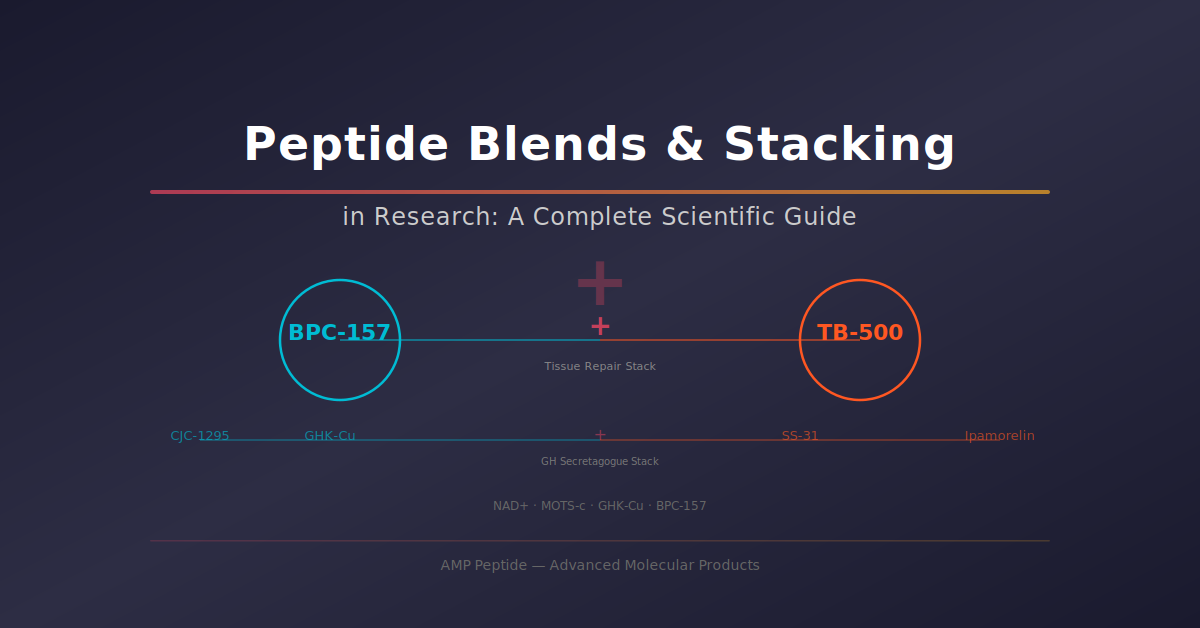
Peptide Blends & Stacking in Research: A Complete Scientific Guide
Peptide stacking — the concurrent administration of two or more peptide compounds in a controlled research setting — represents an emerging experimental paradigm that moves beyond single-compound investigation toward understanding multi-target biological modulation. While most peptide research focuses on isolated compound effects, the biological reality is that signaling peptides operate within complex, interconnected networks where simultaneous modulation of multiple pathways may produce effects distinct from the sum of individual compound actions.
This guide provides a comprehensive scientific overview of established and proposed peptide combinations studied in research contexts, including the mechanistic rationale, known interactions, and experimental considerations for each stacking approach. It is important to note that peptide stacking is a research methodology — not a clinical recommendation — and requires careful experimental design to distinguish additive, synergistic, and antagonistic effects.
What Is Peptide Stacking in Research?
Peptide stacking, in the context of research investigation, refers to the deliberate combination of two or more peptide compounds to investigate whether their concurrent administration produces biological effects that differ from those observed with individual compounds alone. The rationale for studying peptide combinations rests on several pharmacological principles:
- Mechanistic complementarity: Compounds targeting different pathways in the same biological process may produce more comprehensive effects when combined.
- Dose reduction: If compounds act synergistically, lower individual doses may achieve comparable effects with potentially reduced off-target activity.
- Receptor cross-talk: Many peptide signaling pathways intersect at downstream points, creating opportunities for pathway interaction studies.
- Compensatory pathway recruitment: Single-compound interventions may trigger compensatory responses that dual interventions could mitigate.
Peptide stacking is distinct from sequential administration studies (where compounds are administered in series at different time points) and from fixed-ratio combination products. Instead, stacking research typically involves concurrent administration with controlled dosing schedules designed to evaluate interaction effects.
Principles of Peptide Combination Research
Before examining specific combinations, it is essential to understand the scientific framework for evaluating peptide interactions:
The most commonly studied peptide combinations in research fall into several categories based on their mechanistic rationale. Below we examine each major combination with its proposed mechanism, research evidence, and experimental considerations.
BPC-157 & TB-500 (Thymosin Beta-4): The Tissue Repair Stack
BPC-157 (Body Protection Compound-157) and TB-500 (the active fragment of Thymosin Beta-4) are among the most widely discussed peptide combinations in tissue repair research. The scientific rationale for combining these two compounds rests on their complementary but distinct mechanisms of action in tissue healing.
BPC-157 is a stable gastric peptide derivative that has been studied for its effects on angiogenesis, nitric oxide (NO) pathway modulation, and growth factor regulation. Research suggests BPC-157 upregulates vascular endothelial growth factor (VEGF) and basic fibroblast growth factor (bFGF), promoting new blood vessel formation and accelerating tissue repair processes. It also influences the NO system and exhibits anti-inflammatory effects through modulation of pro-inflammatory cytokine expression.
TB-500 (Thymosin Beta-4 fragment) is a synthetic peptide that promotes cell migration, cytoskeletal reorganization, and extracellular matrix remodeling. Its primary mechanism involves sequestering G-actin monomers and promoting actin polymerization, which is critical for cell motility during wound healing. TB-500 also upregulates matrix metalloproteinases (MMPs) that facilitate tissue remodeling and has been investigated for its effects on cardiac repair and corneal wound healing.
Proposed synergistic mechanism: BPC-157’s angiogenic effects (creating new blood supply to injured tissue) combined with TB-500’s cell migration and matrix remodeling activity (facilitating cellular infiltration and tissue reorganization) may produce more comprehensive tissue repair than either compound alone. The angiogenic and chemotactic pathways are non-overlapping, minimizing the risk of receptor-level competition.
Related products at AMP Peptide: BPC-157 (5mg, 10mg) and TB-500 (5mg, 10mg).
CJC-1295 & Ipamorelin: The GH Secretagogue Stack
The combination of CJC-1295 (a GHRH analog) and Ipamorelin (a GHRP agonist) represents a well-documented strategy for investigating the growth hormone (GH) axis through dual-pathway stimulation. The rationale is based on the physiological regulation of GH secretion, which depends on the coordinated activity of two hypothalamic factors: growth hormone-releasing hormone (GHRH) and ghrelin (acting through the GHSR-1a receptor).
CJC-1295 with DAC (Drug Affinity Complex) is a long-acting synthetic analog of GHRH (1-29). It stimulates the pituitary to release GH by activating the GHRH receptor on somatotroph cells. The DAC modification extends the peptide’s half-life by binding to endogenous albumin, producing sustained GHRH receptor activation over an extended period compared to unmodified GHRH analogs.
Ipamorelin is a synthetic pentapeptide GHSR-1a (ghrelin receptor) agonist that stimulates GH release through a mechanism distinct from GHRH. Unlike earlier GHRP compounds (such as GHRP-2, GHRP-6), Ipamorelin was designed to be more selective for GH release with reduced effects on ACTH and cortisol pathways, making it a more targeted research tool for GH axis investigation.
Proposed synergistic mechanism: GHRH analogs (CJC-1295) and GHSR-1a agonists (Ipamorelin) act on different receptors on the same somatotroph cells, producing greater GH release than either stimulus alone — a phenomenon known as the “GHRH + GHRP synergy.” Research has demonstrated that the combination produces a greater GH pulse amplitude than the sum of individual effects, suggesting true synergy at the pituitary level.
Related products at AMP Peptide: CJC-1295 (2mg) and Ipamorelin (2mg, 5mg).
GHK-Cu & BPC-157: The Skin & Wound Healing Link
The combination of GHK-Cu (a copper-binding tripeptide) and BPC-157 (a gastric peptide derivative) represents an interest-driven research intersection between cosmetic peptide science and tissue repair biology. While these compounds are structurally unrelated and target different molecular pathways, their effects on wound healing and tissue regeneration overlap at a functional level.
GHK-Cu is a naturally occurring copper peptide that modulates collagen synthesis, MMP activity, and gene expression in fibroblasts and keratinocytes. Its effects are primarily mediated through copper-dependent enzyme activation (including superoxide dismutase and lysyl oxidase) and broad gene regulatory changes related to extracellular matrix remodeling.
BPC-157, as described above, promotes angiogenesis and tissue repair through VEGF upregulation and NO pathway modulation.
Proposed mechanistic rationale: BPC-157’s angiogenic effects establish improved blood supply to healing tissue, while GHK-Cu’s collagen-regulatory and antioxidant effects support extracellular matrix quality at the repair site. The combination may provide both the vascular infrastructure (BPC-157) and the matrix-building signals (GHK-Cu) needed for comprehensive tissue repair research.
Reference: GHK-Cu Explained: Copper Peptide Biology, Skin Regeneration, Evidence & Safety and Peptides for Tissue Repair & Recovery: Complete Scientific Guide.
NAD+ Precursors & Metabolic Peptide Combinations
Combinations involving NAD+ and mitochondrial-targeting compounds represent a growing area of metabolic research. The hypothesis underlying these combinations is that NAD+ provides the electron carrier substrate for mitochondrial metabolism, while mitochondrial peptides optimize the efficiency of the organelles themselves.
NAD+ + MOTS-c: This combination is studied for metabolic research, where NAD+ provides substrate for sirtuin activation and electron transport, while MOTS-c activates AMPK-dependent metabolic signaling pathways. The convergence of sirtuin activation (NAD+-dependent) and AMPK activation (MOTS-c-dependent) at the PGC-1α coactivator level may produce coordinated effects on mitochondrial biogenesis and metabolic adaptation.
NAD+ + SS-31: This combination pairs NAD+’s role as an electron carrier with SS-31’s protection of mitochondrial membrane integrity. The rationale is that SS-31 preserves the structural framework for efficient electron transport, while NAD+ provides the substrate for the transport chain itself. In mitochondrial dysfunction models, combining membrane stabilization (SS-31) with substrate availability (NAD+) may be more effective than either intervention alone.
Related products: NAD+ (500mg, 1000mg), SS-31 (5mg, 10mg), MOTS-c (5mg).
Comprehensive Stack Matrix
| Combination | Primary Compound 1 | Primary Compound 2 | Mechanistic Rationale | Research Domain |
|---|---|---|---|---|
| Tissue Repair Stack | BPC-157 (angiogenesis, NO modulation) | TB-500 (cell migration, matrix remodeling) | Vascularization + tissue remodeling | Wound healing, tissue repair |
| GH Secretagogue Stack | CJC-1295 (GHRH receptor) | Ipamorelin (GHSR-1a receptor) | Dual somatotroph stimulation | GH axis, metabolic research |
| Skin & Wound Stack | GHK-Cu (collagen, gene regulation) | BPC-157 (angiogenesis) | Matrix quality + blood supply | Skin repair, dermatology |
| Metabolic Stack | NAD+ (sirtuin substrate, ETC) | MOTS-c (AMPK activator) | Sirtuin + AMPK pathway coordination | Metabolism, mitochondria |
| Mitochondrial Protection Stack | NAD+ (electron carrier) | SS-31 (cardiolipin stabilization) | Substrate + membrane integrity | Mitochondrial dysfunction |
| GH Peptide + Metabolic | CJC-1295 or Ipamorelin | MOTS-c or NAD+ | GH axis + metabolic optimization | Body composition, metabolism |
Research Considerations for Peptide Stacks
Investigating peptide combinations introduces several unique research challenges beyond those encountered in single-compound studies:
- Pharmacokinetic interactions: One peptide may alter the absorption, distribution, metabolism, or elimination of another. Simultaneous administration does not guarantee simultaneous bioavailability at target tissues.
- Receptor desensitization: Chronic combination administration may accelerate receptor downregulation or desensitization compared to either compound alone, particularly if both act on the same cells.
- Dose-response complexity: Interactions may be dose-dependent, meaning the combination may produce synergy at one dose ratio but antagonism at another. Full dose-response matrices (checkerboard assays) are rarely feasible with peptide research.
- Endogenous feedback disruption: Combining compounds that activate the same physiological axis (e.g., dual GH secretagogues) may disrupt endogenous feedback regulation more profoundly than single compounds.
- Endpoint attribution: When combining two compounds with overlapping effects (e.g., both affect collagen synthesis), attributing outcomes to specific mechanisms becomes challenging without pathway-specific biomarkers.
- Timing and sequence: The temporal relationship between compound administrations may significantly affect outcomes. Some combinations may require staggered administration to avoid competitive effects.
Researchers investigating peptide stacks should consider factorial experimental designs that include individual compound groups, combination groups, and appropriate vehicle controls to distinguish additive effects from true synergy.
References & Further Reading
- Peptides for Tissue Repair & Recovery: Complete Scientific Guide
- Growth Hormone Secretagogues & GHRH Analogs: Research Guide
- GHK-Cu Explained: Copper Peptide Biology, Skin Regeneration, Evidence & Safety
- Mitochondrial Peptides in Research: A Complete Scientific Guide
- Wellness & Functional Peptides: Research Guide
- AMP Peptide Product List — Tissue Repair & Recovery
- AMP Peptide Product List — GH Secretagogues & GHRH Analogs
- AMP Peptide Product List — Metabolic & Cellular Research Compounds